Necessary Equipment for Painting Miniatures
There are quite a few "nice to have" pieces of painting equipment to consider, and some that you absolutely need.
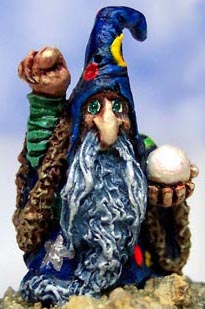
I found this miniature tucked away in among the long-discontinued section of a games shop. Sometimes you can find nice pieces that way.
Lighting
The first thing that you will need, and something often overlooked by beginning miniatures painters is a suitable work area. The most important aspect of where you paint is the amount and type of lighting. I prefer to have a mixture of florescent and incandescent (light bulb) lighting.
I use two desk lamps when I paint. The first one is an incandescent light source. It works well for casting harsh shadows, which helps me to know where washes should settle, since washes represent areas in shadow. You should be able to purchase a passable desk lamp for $10-$20. I suggest an arm lamp, one that clamps onto your desk or work surface. I prefer one that is designed to handle up to 100 watt bulbs as I use a full 100 watt soft bulb.
The second light that I use is a florescent light, which circles a magnifying glass. This works especially well, since the miniature is lighted from all angles for general painting work.
Good lighting will be one of the most critical elements to your success.
I have a lighted magnifying glass like this one, and it has been amazing to use! It makes details easy to see, and helps me to put the paint right where I want it.
Clothing
Be sure to wear clothes that you don't mind getting paint on. No matter how careful that you try to be, every now and again you will get some on your clothes, so take appropriate precautions. A kitchen apron will work fine as well. It is also a good idea to put down newspaper under the area that you will be working on to keep paint and ink off your tabletop. Again, just common-sense things to consider.
Selecting Equipment
When selecting equipment to get started, I would recommend avoiding brand loyalty. When it comes to paints, brushes, and so on, focus on what is most functional for you and the price that you pay for it. I have included a Materials Cost Guide to aid in the purchase of the various equipment that you will need.
Brushes
You will need a selection of brushes. I would recommend a size 2, 1, 000, and 5/0. These should suffice for most painting that you will do. Especially with the smaller ones, make sure that the brushes that you are buying come to a good point, with no hairs badly out of place. If, after you have used a brush for a while, an unruly hair begins to stick out, snip that hair off near the ferrel of the brush (the metal part) with a pair of fingernail clippers. Make sure that you only remove the one hair that is out of place.It is important that you take good care of your brushes as they tend to be quite expensive. Make sure that you clean out every bit of paint possible from them after each use with warm, water. You can use some liquid dishsoap to help to clean them out, but lots of water will do the trick usually. NEVER clean up a brush with hot water! The glue that holds the bristles into the brush can melt. This will result in hairs falling out as you paint. The brush will be useless and need to be thrown away. After washing the brush it is very important to form the tip of the brush into its point. A brush could be said to have a memory that it remembers what shape it was when it dried last. Never leave a brush in a container of water to soak. This will bend the bristles and ruin the point, which is very important to get crisp lines and to be able to get into hard to reach places.
You will need a flat size 2 brush and a size 4 flat brush for drybrushing, a technique that we will discuss later. It is my recommendation that these be natural bristled brushes of sable. The round brushes can be either natural or manmade bristles. The natural bristles tend to be softer and work well with blending, where the manmade ones tend to be stiffer, which is good for getting into hard to reach places. Personally, I use natural brushes almost exclusively, a red sable.
Many painters will say to use nothing but red sable, but I think that this is a matter of personal preference. I recommend getting a multipack of brushes at a craft store to start with. They will be much cheaper this way over buying them separately. For your very fine brushes though, you may want to hand pick these to get the best points. It is not as important how few bristles that the brush has as it is how good of point that the brush has. One reason that I use red sable is that if you reshape the brush after each washing, you can almost always get a good point out of it. Once nylon brush bristles get bent, no amount of reshaping will get them back to their original state.
Featured Product
Kolinsky sable brushes like these last a long time and keep their shape and spring well. At this price, most anyone can afford really excellent brushes. The quality of the brush makes more difference in your painting than any other factor, in my experience.
Paints
This brings us to the next point, that of what type of paints to use. I recommend acrylic paints, the kind found in craft stores like Hobby Lobby, Michael's, or Jo-Ann Fabrics. They clean up and thin easily with warm water. One can clean them up with mild liquid dish soap as well. They tend to be smooth and often somewhat thinner than enamels. They also tend to be less opaque than enamels. The color that you base coat with determines to large degree the warmth or coolness of the paint applied over it.
Enamels
Some painters use enamel paints and swear by them. It must be kept in mind that enamels are a lot more trouble in that they dry slower and clean up is more difficult. Acrylic paint will take along the lines of 10 minutes or less to dry (normally under 5 minutes), where enamels can take up to an hour to dry. Also, the paint thinner can be abusive to brushes and adds the problem of fumes. If you will be using enamels, ensure proper ventilation in your work area.
There are times when they are more effective than acrylics. Areas where enamels excel are in metallic or very bright colors. If one is careful in selecting metallics and bright colors, usually an acrylic or water-based enamel gives comparable results to enamels. In short, I feel that enamels are best left to more seasoned painters. I do not cover the use of enamels in my discussions with the exception of water-based enamels.
Oil Paints
Oil paints are used by some because of their excellent blending properties. They tend to be MUCH more expensive than acrylics, require special (often very smelly) thinners to clean your brushes, and take FOREVER to dry unless you use an additive to accellerate the drying time. I would have to say that unless you are an expert painter, avoid oil paints in almost all instances. Oil paints tend to cover well and will spread nicely, so there are advantages to them, just not enough of them for me to use myself.
Water-based
Enamels
Water-based enamel paints are simply-put the best paints that I have used to this point. Water-based enamel metallics that I have used have extremely fine particles and are extremely shiny. Bright colors are vivid, especially the flourescent colors. Water-based enamels have been extremely hard for me to find and expensive as well. I discovered water-based enamels in a clearance bin at a craft store and have not found a good source for them unless one buys 6 of one color at a time at around $4.00 per large pot. If anyone out there finds a source for these type of paints, please email me and I will post the information on this page.
Acrylic Paint
Though this is not meant as an advertisement for their products, I personally use mainly Delta Ceramcoat paints. I can usually get them for about $1.25 each on sale at craft stores like Hobby Lobby, Michael's, or Jo-Ann Fabrics for a 2 fluid ounce bottle. Compare this with most miniatures paints, which come in .5 fluid ounce containers. With Ceramcoat paint, I'm getting four times as much paint, for about a third the cost.
Do the math. You pay three times as much for a quarter as much paint. You're paying at least 12 times as much for acrylic miniature paint, and for everything except the metallic paints, I can't detect a difference at all.
It doesn't cost a lot to have a good selection of paints at $1.25 per color, and with 2 ounce bottles, you won't run out of the color anytime soon, either.
Many companies sell packs of paint six or eight at a time aimed at miniatures painting. I prefer to buy exactly the colors that I feel that I will use most, but when you are first starting out, getting a good set of basic colors can be an economical way to get started.
What I Use: Featured Product
Delta Ceramcoat is my "go to" miniatures paint. It's very cost-effective, so you can have a lot of colors for not a huge investment, and the testing that I have done shows that there is really minimal to no difference in coverage, compared to paints sold by miniatures companies like Reaper or Vallejo.
Many miniature painters have never tried these paints, because they have been told that they have inferior coverage, won't stick to miniatures, etc. None of these things is true, but go with whatever works best with your painting methods.
However, if you're just starting out, I would recommend trying the Delta Ceramcoat line of paints. It will cost you less to get started, and you'll be able to afford a broader range of colors to start with.
I highly recommend the set of 16 colors in the product link to the right.
The colors that you may want to buy from a miniatures company are gold and silver, even if you pay more for them. Some craft paints do a poor job with metallics, though they will have many colors that are often not available from miniatures companies. Cheaper metallics can sometimes have coarser metallic particles and don't spread or dry evenly in some cases. I have various kinds of paints available in tubes, squeeze bottles, and pots. For dispensing paints, I dislike the little pots of paint, as it is easy to get cross-contamination of color from one pot to the other. The squeeze tubes or squeeze bottles allow one to dispense exactly the amount of paint onto your pallet. The open pots can dry out or get thicker over time, since one most often uses the paint right out of the pot.
When you have success with a product, don't concern yourself so much about who makes it as how good of a value that you are getting. Better value means more colors to choose from. The one possible exception to this is if you are painting an army of miniatures and you want them to have a specific look. OK, I will go ahead and be blunt, if you are painting a Games Workshop™ army, you may want it to look exactly like the ones featured in White Dwarf™, their trade magazine. In that case, you will pay two or three times as much for their paint, but it may be worth it to you to get exactly the same effect as other Games Workshop™ armies. Even so, you won't find "Gore Red™" or "Bile Green™" at a craft store (for some reason  ), but you should be able to find a color that is extremely close.
Featured Product
Reaper makes great paints, and this exellent paint set gives you what you need to get started and hit the ground running.
Recommended Colors: The colors of paint that I recommend purchasing to start with are flesh, red, yellow, blue, brown, black, white, silver, and gold. You will eventually want to invest in the secondary colors: green, purple, and orange. You can get really great effects with pearlescent white added to other colors. If you will be doing blending, you will want to purchase some drying retardant, sometimes known as "extender". When blending, this keeps the paint from drying as rapidly while you apply colors progressively closer to the target color.
Additional Colors: Eventually you may want to buy a good set of metallic colors. You can mix them yourself by mixing various colors with either silver or gold. Most metallic colors can be mixed in this way. It is nice, however, to be able to recreate just the precise color that you used in the past. This is especially useful if you have to touch up a miniature, which you often end up having to do if you handle your pieces a lot.
The metallic paints that I use are put out by craft companies such as Apple Barrel, Americana, and Creamcoat. The thing to look out for in metallic paints that are not manufactured by miniatures companies is the size of the metallic particles in the paint and how well the paint covers. Since more traditional craft paints are for use in covering larger areas than one typically does in the painting of miniatures, these factors are not as important for those crafts than they are for painting miniatures. Ideally you want a paint that has very small particles and cover well. Pick up the bottle and hold it close to your eye. If you can see individual flakes of the metallic powder that is used to make the paint with, hesitate to buy it. Some metallic paints are a bit thick for use with miniatures, and may cover too thickly, making it difficult to see detail on the miniature. If your paint falls into this category, thin it with a little water or extender. The best metallic set that I have found is put out by Armory™, but my recommendation is to look at all of the lines available and to pick and choose your colors without respect to just brand name.
Besides metallics, you may want to purchase your flesh color and your white from a miniatures manufacturer. A good flesh tone is hard to find. Most of them are too light, to the point of leaving your piece looking like an albino. Keep in mind that the actual color that you will end up with will be darker than what is first applied if you wash the miniature afterwards, a technique discussed later. Make sure that the white that you purchase is sufficiently bright as well, especially if you will use it as a basecoat. Your colors cannot be any brighter than the basecoat beneath it, since most paints are not totally opaque. Many whites are a bit yellow, which makes it hard to get the brilliant effects that you are often after. Titanium white that comes in a tube from art companies are often quite bright.
Featured Product
This Reaper series of paints gives you colors beyond the basics, to add even more variety to your miniature painting.
Knife: You will need to purchase an Xacto™ knife for removing flash (the mold lines on the miniature) from figures.
Palette: You will need to buy a palette, which is a metal or plastic plate with concave areas for mixing paint. An old plate can be used for this if desired. Recently I have moved from traditional palettes to putting the paint that I use directly onto a piece of white shower board that I cut to fit the area in which I paint. I don't run out of room for the paints that I use (my plastic palettes only had 6 or 12 indentaions for paint). This works well for cleanup as well, since with the acrylic paints that I use, the paint comes off easily when it dries with just my thumbnail. This saves trips to the sink to clean one's palettes. The shower board also gives you a lot or room for mixing paints. With the white background, you can more easily see what the color will look like when on a white basecoat of paint than with a metal or other type of palette. Whichever pallet that you choose, I recommend that it be as bright a white as possible if you will be using white as your base coat. Ideally the palette should be the color of the base coat that you normally use, so that what you see on the palette when mixing colors is the same thing you will see when the paint is applied to your miniatures. When applying most paints, the color that you see is limited in brightness to what it is painted on, or primed with.
Miniature Cleaning: An old toothbrush is required for cleaning the miniature before base-coating it as well as some common dish soap. The toothbrushes that I have had best luck with are the hard toothbrushes, rather than the soft bristled brushes recommended by dentists for cleaning your teeth. The hard bristles get into cracks better to remove paint there and are more abrasive if you will be using them to remove old paint as explained below.
If you wish to remove paint from a minatures at a later time or to repaint miniatures that either you or another miniature artist has applied, the best and safest product that I have found is household Pine Sol®. Other pine-based cleaners may work, but they may have much less pine oil in them than Pine Sol, which is the active ingredient for removing paint. Simply soak the painted miniature in Pine Sol overnight. The pine cleaner does a great job of attacking either acrylic or enamel paint and I have never had it harm a miniature to date, including plastic figures. I have not tried it on the rubbery plastic material used with the Mage Knight™ miniatures, but I suspect that it would be all right. I have some of their minis to remove paint from, so I will try to remember to post my findings here when I do.
Some articles that I have read recommend using brake fluid for the removal of paint. This seems riskier to me, since as I remember the recommendation is for using gloves with brake fluid and I am unsure as to whether it might damage plastic miniatures or the rubber-like material used in Mage Knight miniatures.
Featured Product
Pine Sol is the best product that I have found to strip old paint from miniatures, easily and safely.
Brush Cleaning: You will need some type of container to hold water (or paint thinner, if you are using non-water-based enamels) to wash your brushes in as you go. I use a quart-sized canning jar, as it is heavy and won't tip over as easily as a plastic cup. Dumping an entire glass of water with paint in it onto your carpet can make you downright unpopular at your house for a while to come (or at least that has been my experience). Also a couple of paper towels or napkins are necessary to keep close at hand for drying your brush after washing it and for drybrush techniques.
Glue: For multi-part figures and for those that require glueing bases on, either super glue or two-part epoxy will work fine.
Superglue tends to dry faster (almost instantly) whereas the epoxy takes from 5-20 minutes. Super glue bonds well if you have two smooth, flat surfaces to adhere together. Miniatures glued with superglue seem to break apart more easily than the multipart miniatures that I have attached with epoxy glue. I recommend superglue for most applications with smaller figures.
If you are glueing rough surfaces together, epoxy glue fills in gaps, where superglue does not. Epoxy is somewhat flexible, which may account for the difference in durability when compared with superglue. Use epoxy for larger multipart figures. For the most part, I prefer the 5-minute epoxy. It has proved more than strong enough for the multipart miniatures that I have put together. The longer-drying epoxy glues is supposed to be stronger, but I have not found the 5-minute epoxy lacking for strength.
Ribbon tape epoxy, sometimes known as "plumber's putty" can also be used if desired, but if you need the putty type of epoxy, use Milliput or a similar modeller's ribbon epoxy. The standard plumber's putty can be messy and smelly.
You will need a bottle of household/craft glue (Elmer's™ Glue-All™ works fine) and a box of fairly coarse common sand for use when basing your miniature.
E-6000 is hands-down the best and most versatile adhesive that I have ever used. I still use super glue for gluing and pinning multipart miniatures together, but for most everything else, E-6000 is the best!
Spray Fixant/Sealer: You will need a can of matte-finish (not shiny) spray fixant. This is to protect the paint from damage during handling of the miniature. Any drafting, craft, or hobby store should carry spray fixant. I recommend getting some which is manufactured by a miniatures company, as the spray tends to be finer and more uniform.
The nozzles on common spraycans are meant to cover large areas, which do not require as fine of a mist. Also, you are applying much thinner coats of sealant than one would do when protecting a piece of furniture. If you don't know what you are looking for, ask a hobby shop owner and he/she can show you what you need.
Expect to pay more for a small can of sealant distributed by a miniatures company than for a larger can of common sealant. Dullcoat™ can be used to good effect as well, which is often sold at train or dollhouse hobby stores.
I love Testers Dull Coat for it's non-reflective matt surface.
Inks: Optionally you can purchase inks for washing. As you will probably want to keep expenses down to begin with, this is not necessary and can be gotten around. Drawing inks work well, which can be purchased at a drafting or art supply store. Brand name is a personal thing, but I think that Pellican™ makes a good, inexpensive ink that works well for washes that does not have surface tension problems which others might have. I would recommend a good red, blue, purple, black, and green as inks to buy. Yellow would be very optional, but you might find it useful when washing white areas. White is nice to have for mixing with other colors of ink. This gives your inks much of the qualities of "pigmented" inks. My personal preference is not to use pigmented inks, as they can sometimes be "muddy" in their coverage and do not make for as high of contrast as the non-pigmented inks. If you want lower contrast in your washes, you can add white to the non-pigmented inks to get almost the same effects.
Again a warning as to your clothes. Inks are very unforgiving when it comes to stains. You can expect to pay about $2.50 each for stains. This is pretty good since you will pay $15 or more for a set of 6 prepackaged inks from the companies that manufacture miniatures. You get a slight savings when buying brand name drawing inks, but the real savings is that the drawing inks come in bottles that are twice the volume at the same price or less. Also you can mix and match a lot more. Pellican puts out about 10 colors of ink that I am aware of from yellow to black.
I use inks to bring out very sharp detail, especially in washes. India inks work great for this, and this is a great deal on a dozen colors of ink!
"Hands Free Vise": Another thing that you may want to eventually pick up is something called a ""hands free vise"." It consists of a heavy base with an arm(s) coming from it with alligator clips at the ends to steadily hold a miniature in any position while you work on it.
It will help to keep you from rubbing off painted areas of your figure before the miniature is sealed or those that are still wet when you are working with it.
Often when you are washing a miniature, you will need to keep the miniature tilted at a specific angle while the ink dries to prevent the ink from creeping into areas where you do not want it.
A "hands free vise" will also help you to keep a steady hand while painting. You can purchase one at Amazon for around $8-$10.
A hands-free vice and magnifying glass like this makes it easier to hold your miniature steady while you're working on it, and to see fine details. I highly recommend getting one early on.
Files: You might eventually want jeweler's files for removing flash from a minature or for atlering or "converting" it. They can be purchased at most any hobby shop and typically run about $2 each. Most flash is removed with a hobby knife, but they work well for the final touches.
Also, with some of the harder metals with which some miniatures are cast, it can be difficult to remove excessive flash with just an X-Acto knife. These files are great, especially curved "riffler files" like the featured product shown.
I have compiled a complete checklist of necessary materials, along with what you are likely to pay for each.
Next Topic: Getting Started >>
Curved jeweler's files like these make removing flash from metal miniatures a breeze!
worth a few dollars/Pounds/Euros?
I don't sell anything on this site, and I provide all information free of charge, so if this site has helped you, please consider donating to help support adding more content to this site. Just click on the Tip Jar image above.
If everyone pitches in just a few dollars/Pounds/Euros, I can add videos and more tutorials to serve you even better.