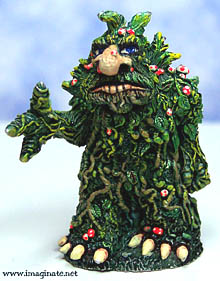
Without a light undercoat, the
light areas of this piece would have looked drab. I
basecoat almost all miniatures with white. You can even
basecoat white and wash the basecoat with black for
really dramatic, high-contrast effects.
Painting
a miniature involves several steps to achieve results that
you will be really pleased with. The basic steps are listed
below. The temptation is to dive right in an begin painting.
This will give results that you are unlikely to be happy with.
Take it slow and you will find that the end, in this case,
justifies the means.
Prepare
Miniature
Plan
& Basecoat
Apply
Wash
Drybrush
Base
You
will want to wash the figure with soapy water. During the
casting process a layer of separation powder or fluid can
remain on the miniatures when the two halves of the mold are
separated.
Next,
mount the figure on its base if the base is separate. I find
that either hot glue or super glue work well to attatch the
figure to its base. For slotted bases, I apply glue along
the narrow ridge that fits into the slot and then insert the
ridge until the glue dries. Once dry, I fill in the gaps in
the slot with hot glue, to keep the ridge from moving within
the slot and breaking the bond.
It may be necessary to remove any uneven areas on the bottom
of the figure itself so that it will sit level on the base.
Miniatures that use a separate base tend to come in two types,
the flat square or rectangle type and the same type, but with
a slot in it. The latter type are compatible with miniatures
that have no flat base, but rather a long vertical ridge which
the miniature is connected to at the feet of the miniature.
If you are assembling one such miniature, the ridge will fit
nicely into the slot. It will need to be glued there by putting
some super glue on the ridge and then inserting into the slot.
Super glue works best when a small amount is evenly spread
over the entire surface area that will be in contact with
the base and form the bond. If putting glue on the ridge will
not glue it sure enough, glue can put put on the bottom of
the feet of the miniature to give more glued surface area.
Once
the miniature is glued to the base, the molding lines, or
flash,
must be removed. The best technique for this is to take a
very sharp xacto knife and scrape along the flash line. The
flash, the lead that seeps out of the mold when the miniature
is cast, will peel off with not too much trouble if the knife
is sharp. Be careful that you are not drawing the knife toward
your thumb or hand as these knives are very sharp and can
give a nasty cut. In the light of envirnonmental concerns
about lead, especially with small children around, either
do your flash removal outside where the filings go where they
cannot do any harm, or if you are inside, place newspapers
under your work and when done, carefully roll them up and
throw them away, not allowing any of the lead filings to fall
out onto the floor. Learning disabilities have been linked
to children having exposure to lead at a young age.
If
you are working with plastic or resin
miniatures, the process is the same, but more care must be
taken to assure that the knife is sharp and that one uses
light pressure when removing flash. For metal figures, a small
file can be used to get into small areas, but such should
not be done with plastic miniatures. If, after removing the
flash, one finds pits in the miniature, these can be filled
in with Testors® filler or with modelling putty, such
as Milliput. The figure can also be sanded to take off
any bumps that result from the molding process.
Once
the figure is thus prepared, it is time to prime the figure.
I use spray enamel paint, the cheap kind found at hardware
stores. Depending on the effect that you want, you can use
any color to prime the miniature with, but as a general rule,
white is by far the best, or perhaps a light grey. It has
been my experience that when a darker color is used, it is
very difficult to get colors bright which are painted over
it. On the other hand, when using a light or white undercoat,
it is often difficult to achieve dark shadows in the depressions
on the figure that are to be shadowed. An alternate methood
is to paint white and then brush black into the cracks before
the base coat is applied. This will allow highlights to be
bright and shadows to be darker, higher contrast. If you are
doing something metallic, some have suggested spraying the
undercoat with chrome or silver. Once it is painted over,
one can take a piece of tape that has been made less sticky
by sticking it to a piece of cloth or one's pants and then
ripped off, which can be stuck to the paint over it once done,
which will lift off small specks of the exterior paint, leaving
silver specs, as if the paint were peeling. This is good for
vehicles or robots. Otherwise, I would advise sticking to
white.
When
the piece has dried, we are ready to do the base coat. Before
starting to paint, it is a good idea to envision what the
piece will look like when done. It is best not to charge into
a figure without considering the whole color scheme that will
be used. Colors should be chosen that will go well together.
If something is meant to stand out, one should pick colors
that highly contrast them. For a color to contrast with another
it must be either brighter or darker than the color to be
contrasted against or on the opposite side of the color wheel,
which is reproduced below. A short discussion of color theroy
will follow.
What
are called the 'primary colors' are red, yellow, and blue.
They are thus called because all other colors can be made
by mixing different combinations of them along with white
added to lighten a color or black to darken it. The colors
in between these are those that result from mixing the two
colors in even proportions. Red and blue make purple, blue
and yellow make green, and yellow and red make orange. Purple,
green, and orange are called the secondary colors.
These
can be mixed with their neighboring colors to come up with
even more colors. It is often beneficial to actually make
a color wheel for your own use as a guide.
When
purchasing paints, it is important to make sure that you have
one of each primary color as well as black and white. I suggest
buying brown, metallic silver, and metallic gold as well.
This will give you the basis of what you need to get started.
As said above, if you have little experience with painting
and/or color theory, it would be good to take a piece of white
construction paper and make a color wheel of your own so that
you will know what colors that you can get out of your basic
paints, also called pigments. Start by making a circle of
red, yellow, and blue in a triangle. Then mix one part of
red with one part of blue to make the purple, which we will
make a filled circle of between the blue and red. Do this
as well for blue mixed with yellow, and yellow mixed with
red. The wheel can be furthur expanded out by mixing 1:1 the
red and purple, the purple and blue, and so on around the
color wheel. These colors are called the tertiary colors.
In all we have made a pallete, or color selection, of 12 colors
from our original 3.
As
said before, white can be added to any of these to get a lighter,
softer color. As it gets lighter, it is said to become more
pastel. When black is added, the color becomes darker and
less intense or "saturated". Brown can be added
to make a color more earthy or subdued. Silver and gold are
interesting colors in and of themselves, but they can be added
to mixed colors to give them luster or even to make them shiny.
If a small amount is added, the color will get a satin finish
to it. If one wishes to paint a red silk hat on a figure,
mix up a color of red that is just darker than the color that
you want the hat to be. When you add silver, it will lighten
the color slightly. Mix in a very small amount of silver and
mix thoroughly until no streaks of either of the original
color remain, leaving a well blended satiny red. Experiment
to see what you get by adding more and more silver to the
mixture. You might want to add a blob of metallic and satin
red next to the red circle on the color wheel to remind you
later of colors that you can mix with red and silver. You
could also do this with red and gold to see what you get.
The key point here is experimentation and to be able to see
at a glance what colors that you have available to you when
you sit down to plan the coloring of features for a figure.
It makes it easier to visualize what the piece will look like
when you are done. Continue by mixing silver and gold to each
of the other colors on the color wheel if you desire.
Having
a basic understanding of paints and how colors mix to get
other colors, we can hold up a miniature and plan our painting.
It is best not to rush into a piece and start painting. Once
a miniature is painted, it is a shame to have to remove paint
that took much time to put on in the first place. On the other
hand, miniatures are often not cheap, so you want to get the
best possible effect. If you happen to paint an area and later
change your mind, all is not lost. If the paint is still wet,
you can get a paintbrush saturated with water and brush over
the area, letting the water in the brush mix with the paint
to make a thin wash, which will drip away the color. Care
must be taken not to ruin other painted areas. Even after
acrylic paint is dried it can get an undesireable bumpy surface
if it gets wet before it is spray sealed. More on this later.
If
the paint has dried already and you are not at all pleased
with the outcome of the piece and want to start all over again,
this is possible. Soaking the miniature in Pine-Sol®
or other pine cleaner for a day will do an excellent job of
removing either acrylic or enamel paint. I would recommend
using a major brand of pine cleaner, as the cheaper brands
apparently have less pine oil. The pine oil is apparently
what removes the paint and sealant. I have removed paint with
pine-oil cleaner that I never would have guessed that I could
have gotten off.
I
understand that one can also remove paint with oven cleaner,
but have not used that for some time, and I cannot remember
the exact results that I got. Spray the oven cleaner onto
the figures and then use a mildly abrasive scrub brush to
take the paint off. If there is still paint remaining, repeat
the process.
If the area that you want to correct is small, you can either
paint over it or scrape the paint gently off with an xacto
knife. Painting over mistakes will tend to make buildups which
obscure fine detail of the figure. Scraping must be done with
caution so as not to take off detail or make deep scratches
or gouges in the miniature.
Once
you have decided on a color scheme, you can begin to paint
the base coat. If you are going to do any washings later,
you will want to pick a color that is slightly lighter than
the color that you want to end up with. This is because the
wash will tend to darken the base color before you are done.
I
like to start with the deepest, hardest to get to areas first,
working my way outwards to the most easily accessible areas.
Some painters have described it as painting items on the miniature
"in the order you would get dressed." Since shoes
go on after socks, paint the socks first. This works fairly
well since if you get paint on the shoes when painting the
socks, this area will then get painted over anyway when you
paint the shoes.
This
part of painting the miniature reminds me of the old paint-by-number
paintings. You just fill in the colors. You are trying to
get a nice, opaque covering of each area. If I am going to
wash with inks, I normall will go ahead and do all of the
base colors before proceding. If you intend to wash with paint,
it is best to do one section at a time by doing the base coat,
washing, and then drybrushing, as you will be working with
variations on your base color and won't want it to dry out
before you get done.
This
is an example of blackwashing,
which can be used as an undercoat over which to paint
so that you can get bright brights and dark darks.
One can also use this as a quick accent to a miniature
that you want to use in roleplaying games or otherwise
but don't have time to paint before using them. It
brings out the highlights, and can be done quickly
once you learn how to drybrush
well.